Greek mythology · Heroes & mortals
Laius, king of Thebes and father of Oedipus in Greek mythology
Laius of Thebes: the crime against Chrysippus, an oracle he was warned to obey, the exposure of Oedipus, and death at the Phocian crossroads.
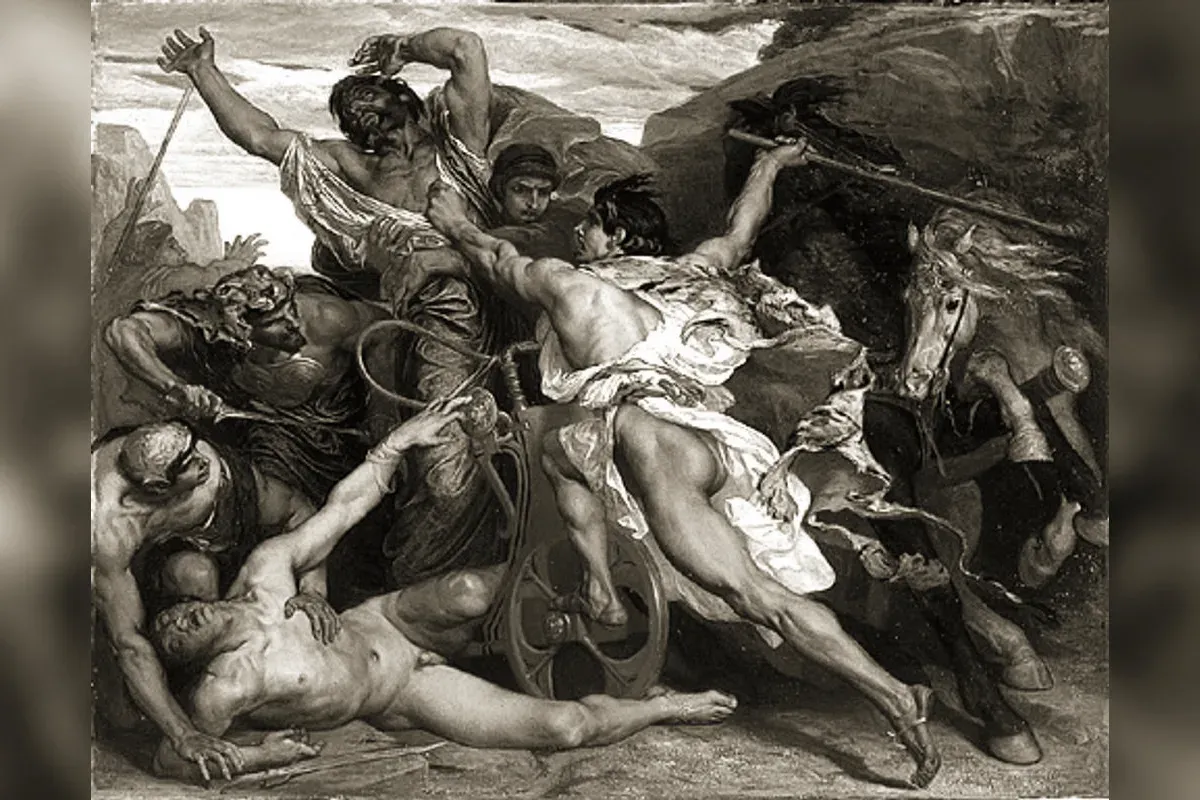
Laius is the king of Thebes whose attempt to escape an oracle carries it out. Husband of Jocasta and father of Oedipus, he is told his own son will kill him, orders the infant destroyed, and dies years later at the hands of the man that infant became. What makes him more than a plot device is that the tradition also gives him a crime of his own, committed before any oracle was spoken.
The crime that comes first
Laius belongs to the house of Cadmus through his father Labdacus, and he loses the throne young. Exiled during the regency of Lycus, he is taken in at Pisa by Pelops.
There, according to a tradition that Apollodorus preserves and that Euripides seems to know, he abducts his host’s son Chrysippus. The act violates hospitality twice over — against the guest-law protected by Zeus, and against the man who sheltered him — and Pelops curses him: let Laius have no son, or let that son kill him. Later Greek writers treated the episode as the origin of pederastic practice in Greece, which is one reason it circulated widely and one reason later moralists were uneasy with it.
This matters for reading the whole Theban cycle. If the curse begins with Chrysippus, the destruction of Laius’s descendants is punishment rather than arbitrary fate, and Apollodorus follows that logic to its conclusion: he makes the Sphinx itself Hera’s penalty on Thebes for the unpunished crime. Sophocles, by contrast, leaves Chrysippus out entirely. His Laius is undone by a prophecy, not by a debt.
What the oracle actually said
The sources disagree about the form of the warning, and the difference changes how guilty Laius is.
In Sophocles’ Oedipus the King, Delphi simply predicts that a son born to Laius will kill him; the king’s response is a defensive act against a stated future. In Euripides’ Phoenician Women, the oracle is a prohibition — Apollo tells Laius not to father a child at all — and Laius conceives Oedipus anyway, drunk, in defiance of an explicit divine order. The Euripidean version turns him from an unlucky father into a man who was told plainly and did it regardless.
Either way the response is identical. The newborn’s ankles are pierced and pinned, and a servant carries him to Mount Cithaeron. The shepherd disobeys and passes the child to Corinth. The name Oedipus, “swollen foot”, preserves the record of what his father did to him.
The crossroads
Years later Laius travels toward Delphi with a herald and a small escort. At the meeting of three roads in Phocis — the schiste hodos near Daulis, a spot ancient travellers were still shown — he meets a young stranger walking alone, and they quarrel over right of way.
Sophocles is precise about who strikes first: the herald shoves the traveller aside, and Laius brings a two-pronged goad down on his head as the chariot passes. Oedipus kills him and nearly all the escort. One servant survives, reaches Thebes, and reports an attack by robbers — plural, a detail Sophocles plants early and detonates late, because that single inconsistency is what lets Oedipus go on hoping he is innocent.
Laius’s death leaves Thebes leaderless in front of the Sphinx. The stranger who solves the riddle takes the vacant throne and the widowed queen. The prophecy required no supernatural machinery to complete itself. It required only a king who tried to outrun it.
Ancient sources
- Sophocles, Oedipus the King
- Euripides, Phoenician Women, 13-20
- Apollodorus, Library, 3.5.5-8
- Pausanias, Description of Greece (10.5) for the crossroads
See also
Frequently asked questions
Who killed Laius, and what did the witness say?
Oedipus killed him at the meeting of three roads in Phocis, in a quarrel over right of way, without either man knowing who the other was. One servant survived and reported to Thebes that the king had been attacked by robbers, in the plural. Sophocles plants that single inaccuracy early and detonates it late: it is the only thing that lets Oedipus keep hoping he is innocent.
Is Laius a victim or the author of his own fate?
Both, depending on the source. Sophocles gives him a prediction and a defensive reaction. Euripides gives him an explicit divine prohibition that he ignores. And a separate tradition, preserved by Apollodorus, makes him guilty long before any oracle: he abducted Chrysippus, the son of the host who had sheltered him, and was cursed by Pelops for it.