Greek mythology · Heroes & mortals
Ismene, sister of Antigone and daughter of Oedipus in Greek mythology
Ismene, daughter of Oedipus: the sister who refuses, then asks to die anyway — and a lost archaic version in which she dies very differently.
Ismene is the daughter of Oedipus and Jocasta, and the only member of her family left alive at the end of Sophocles’ Antigone. She is remembered for a refusal — she will not help bury her brother — and then for trying to be executed for the act anyway. Reading her as simply the cowardly sister misses what Sophocles built her to do.
The one who keeps contact with Thebes
In Oedipus at Colonus the two sisters divide the work of loyalty. Antigone walks with the blind Oedipus and serves as his eyes. Ismene stays connected to the city, and arrives on horseback carrying intelligence: the brothers have gone to war, and new oracles say that whichever side holds Oedipus will win.
It is Ismene, not Antigone, who brings the information that makes her father politically valuable again — and therefore the information that brings Polynices to Colonus to beg, and gets him cursed. Her function in the play is to carry knowledge across a distance that Antigone, tied to her father’s arm, cannot cross.
The refusal
Antigone opens with the sisters alone before dawn. Antigone proposes the burial; Ismene answers with an argument rather than a shrug. They are women, she says, not made to fight men; they are ruled by those stronger than themselves; and their family has already been destroyed by exactly this kind of absolute act — she lists the dead, one by one, as evidence.
Every clause of that speech is factually correct. It is an accurate account of the power available to two orphaned women under a new king, and an accurate reading of what has happened to everyone in their house who chose defiance. Antigone answers none of it. She simply stops speaking to her.
When the burial is discovered, Ismene comes forward and claims a share in the deed. Antigone refuses her the lie: you chose to live, I chose to die. Modern readers often take this as cruelty, and partly it is — but she is also protecting her sister by denying her a confession that would kill her. Creon releases Ismene. She then leaves the play without another line, and is not among the dead counted at the end.
An older Ismene, who died first
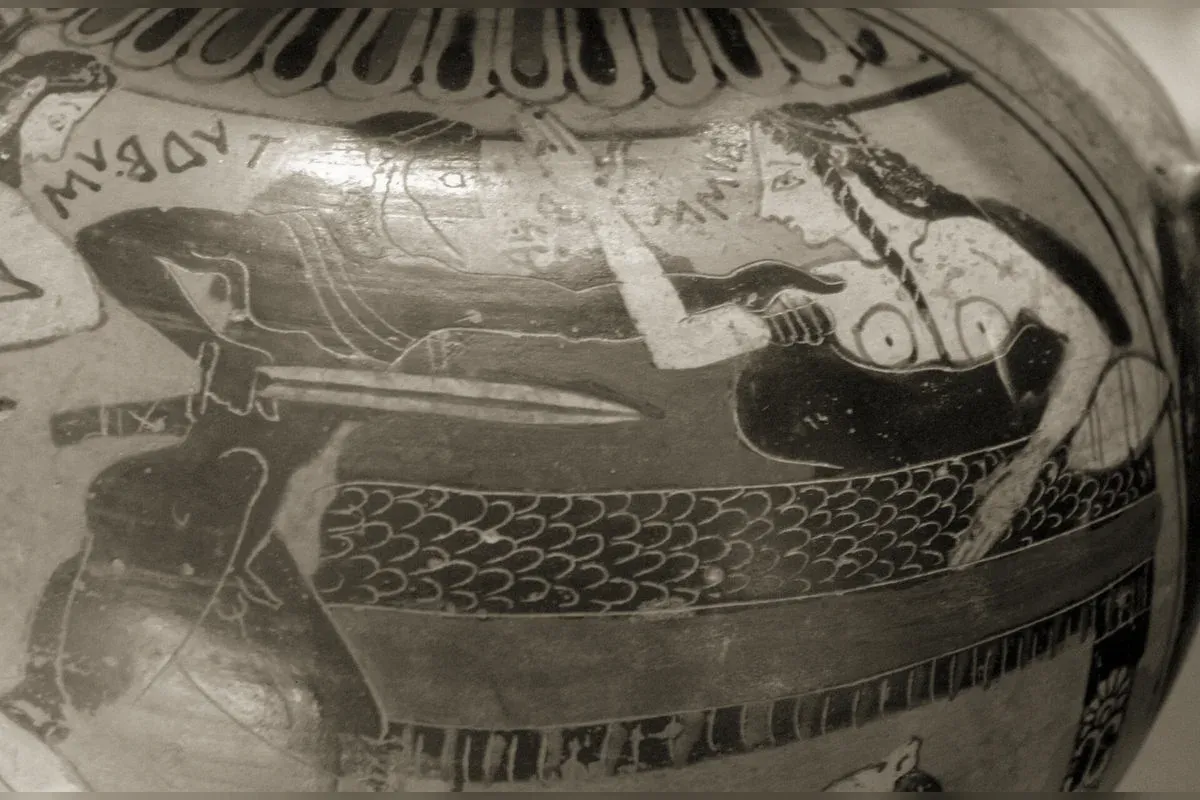
Sophocles’ version was not the only one, and may not be the oldest. Mimnermus, writing in the seventh century BCE, knew an Ismene killed by Tydeus at Athena’s prompting, caught with a lover named Theoclymenus at a spring outside Thebes. A Corinthian amphora of the sixth century shows the scene: a woman on a bed, a man escaping, a warrior striking.
Nothing there resembles the cautious sister of the tragic stage — no Creon, no burial, no ethical dilemma, and a death that arrives long before the war rather than never at all. The divergence is a useful warning about the Theban cycle generally. The versions Athens staged in the fifth century became canonical so completely that they buried the alternatives, and the surviving fragments show a mythology considerably wilder than the one the tragedians selected out of it.
Between the two traditions, Ismene keeps her particular status: the family member who is neither punished nor vindicated, and whose caution leaves almost no trace.
Ancient sources
- Sophocles, Antigone (1-99, 531-581) and Oedipus at Colonus
- Mimnermus, fragment 21 West, preserved by the scholion on Antigone 53
- Corinthian black-figure amphora, Tydeus and Ismene, Louvre E 640
See also
Frequently asked questions
Why does Antigone refuse to let Ismene share the blame?
When the burial is discovered, Ismene comes forward and claims a part in it. Antigone refuses her the lie: you chose to live, I chose to die. Modern readers usually take this as cruelty, and partly it is — but it also saves her sister, since a confession would have been fatal. Creon releases Ismene precisely because Antigone denies her any share in the act.
Is there an older version of Ismene's story?
Yes, and it looks nothing like Sophocles. Mimnermus, in the seventh century BCE, knew an Ismene killed by Tydeus at Athena's prompting, caught with a lover at a spring outside Thebes — a death that arrives long before the war rather than never at all. A Corinthian amphora of the sixth century shows the scene.