Greek mythology · Creatures
Nephele, cloud shaped by Zeus and mother of the Centaurs
Nephele, the cloud shaped like Hera: Zeus's trap for Ixion, ancestress of the Centaurs, and the goddess who sent the ram of the Golden Fleece.
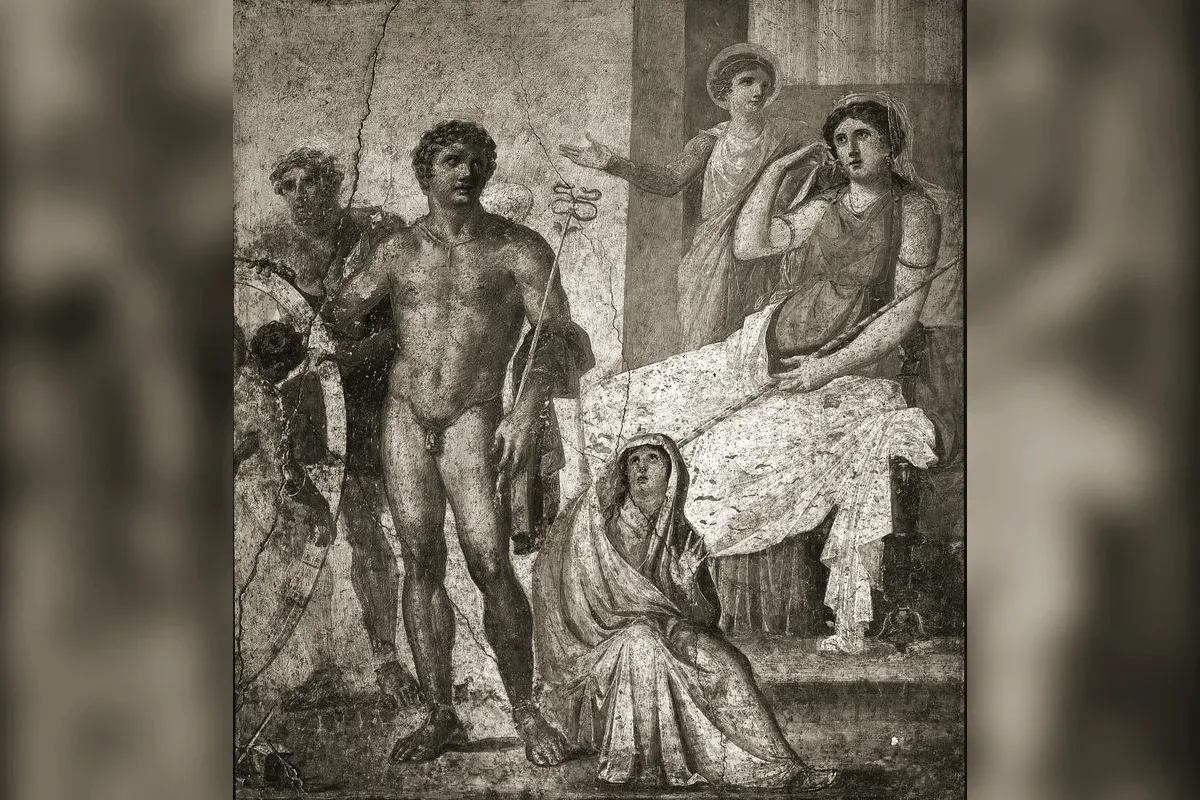
Nephele is a cloud shaped into the likeness of a goddess, and the only entity in Greek myth that begins as a forgery and ends as a mother. Zeus makes her to test Ixion; she becomes the ancestress of the Centaurs; and under the same name she sends the golden ram whose fleece launches the voyage of the Argo.
A trap made of vapour
Ixion, purified by Zeus of a kinsman’s murder and seated at the table of the gods, decides to pursue Hera.
Zeus does not strike immediately. He gathers cloud and shapes it into his wife’s exact likeness — nephele is simply the Greek word for cloud — and lets Ixion take the counterfeit for the real thing. The deception establishes the offence beyond dispute, and it does so by exploiting precisely what Ixion was guilty of: mistaking an appearance of access for the thing itself.
The phantom conceives. Depending on the source she bears Centaurus, who then mates with the mares of Mount Pelion, or she bears the Centaurs directly. Either way, creatures half human and half horse issue from a union between a mortal’s lust and a cloud, which is about as exact an origin as Greek myth ever supplies.
The other Nephele
A goddess called Nephele is also the first wife of Athamas, king of Boeotia, and mother of Phrixus and Helle. Athamas sets her aside for Ino, who plots to have Phrixus sacrificed; Nephele sends a ram with a golden fleece to carry both children away through the air.
Helle falls from its back into the strait that is named the Hellespont after her. Phrixus reaches Colchis, sacrifices the ram, and hangs the fleece in a grove — where it waits for Jason.
Are the two the same Nephele? Ancient sources do not say clearly. The name is a common noun, and a cloud goddess who rescues children through the air is a coherent figure whether or not she is the one Zeus made. Most handbooks treat them as one; strictly, the identification is an assumption rather than a statement in the texts, and it is worth flagging as such.
What a cloud is for
Both stories use her the same way: as an intermediary between the divine and the human that is neither quite.
She is a divine artefact rather than a goddess, made of the substance that sits between earth and sky, indistinguishable from the real Hera and yet not her. Greek myth uses cloud-doubles more than once — Herodotus and Euripides both knew a tradition in which a phantom Helen went to Troy while the real one waited in Egypt, so that the whole war was fought over cloud.
Nephele is the earliest and starkest version of that idea. Something is made to look like what a man wants; he takes it; and what results is real enough to have children, kill people, and start a war.
Ancient sources
- Pindar, Pythian, 2.21-48
- Apollodorus, Library (1.9.1) and Epitome, 1.20
- Diodorus Siculus, 4.69
- Apollonius of Rhodes, Argonautica, 2.1141-1156
- Pindar, Pythian Ode 2
See also
Related entries
Stories featuring this entity
Frequently asked questions
How did Nephele become the ancestress of the Centaurs?
The phantom conceived. Depending on the source she bears Centaurus, who then mates with the mares of Mount Pelion, or she bears the Centaurs directly. Either way, creatures half human and half horse issue from a union between a mortal's lust and a cloud — about as exact an origin as Greek myth ever supplies for the image of appetite without restraint.
Are there other cloud-doubles in Greek myth?
Yes, and the most famous concerns Helen. Herodotus and Euripides both knew a tradition in which a phantom Helen went to Troy while the real one waited out the war in Egypt — meaning the whole conflict was fought over cloud. Nephele is the earliest and starkest version of the idea: something is made to look like what a man wants, he takes it, and the result is real enough to have children and start a war.