Greek mythology · Mythical places
Delphi: Apollo's Oracle and the Navel of the Ancient World
Delphi in Greek mythology: sanctuary of Apollo, seat of the Pythia, and the most influential oracle of antiquity. Mythological role, cult, and enduring legacy.
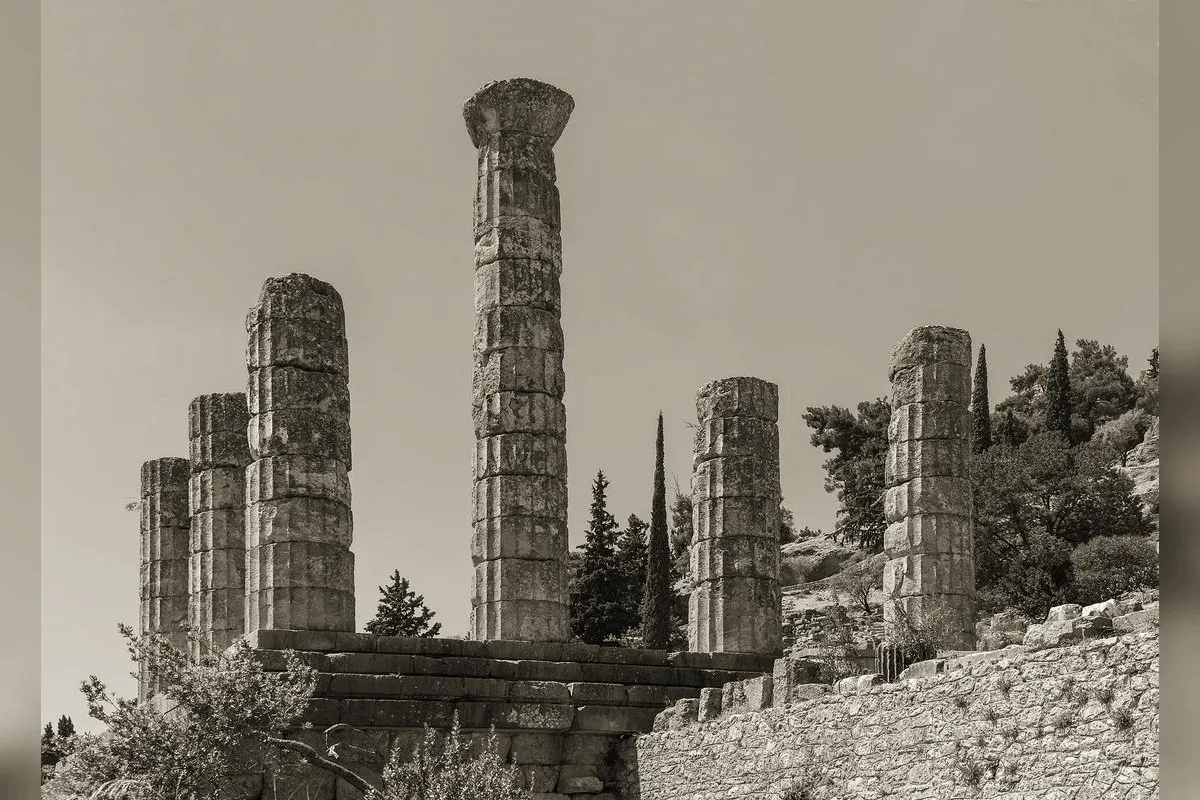
No place in ancient Greece wielded an influence comparable to that of Delphi. This sanctuary perched on the slopes of Mount Parnassus, in the region of Phocis, was far more than a local cult site: it was the spiritual and political centre of the Hellenic world, the place where kings, generals, and city-states came to question the god Apollo before any major decision. To understand Delphi is to understand how the Greeks conceived the relationship between the divine world and the world of mortals.
Pytho before Delphi: the obscure origins of the sanctuary
The site of Delphi was occupied long before the establishment of Apollo’s cult. Archaeological excavations reveal continuous occupation from the Mycenaean period (14th–12th centuries BCE), and ancient literary sources consistently describe an older sanctuary where an chthonic power — connected to the Earth herself — was already venerated under the name of Pytho.
In the most archaic versions, the first mistress of the site was Gaia, the primordial Earth, whose oracle was delivered through a fissure in the rock. Later, this prerogative passed to Themis, goddess of cosmic justice, and was shared or contested with Poseidon, whose domain of earthquakes offered its own mode of making the ground speak. In all these versions, the site is perceived as a point of contact between the depths of the earth and the surface of the world — a place where truth rises from the belly of the soil.
Apollo and Python: the conquest of the sanctuary
The transition to Apollo’s cult is recounted in the Homeric Hymn to Apollo, one of the most precious documents about the founding myth of Delphi. Shortly after his birth on the island of Delos, Apollo travelled through Greece in search of a site for his oracle. He arrived at Pytho and encountered Python — a gigantic chthonic serpent or dragon born from the mud left by the flood, guardian of the Earth’s oracles.
The battle was brutal. Apollo, god of light and clarity, killed Python with his silver arrows — the weapon that symbolises his mastery of distance and precision. The victory was founding in a double sense: it established Apollo as master of the site, and it marked the transition from a telluric oracle, linked to darkness and the depths, to a celestial oracle associated with light and divine reason.
Apollo did not destroy Python’s legacy entirely: he incorporated it. The priestess who would deliver his oracles took the name Pythia, and the Pythian Games founded in his honour would eternally commemorate the god’s victory over the primal monster. Python thus became the invisible foundation upon which the prestige of Delphi rested.
The Omphalos: the navel of the Greek world
One of the most striking traditions attached to Delphi is that of the omphalos — the egg-shaped or domed stone which, according to the ancients, marked the geometric and spiritual centre of the earth. Legend held that Zeus, seeking to determine the midpoint of the universe, released two eagles or two ravens from opposite ends of the world. They met precisely at Delphi, above the future sanctuary.
This stone — a copy of which was recovered during modern excavations and is preserved in the Delphi Museum — was displayed in the temple of Apollo, wrapped in woollen bands (stemmata) and considered to be inhabited by sacred power. It made Delphi not merely the geographical centre of the Greek world but its axis mundi — the point through which the cosmos orients and orders itself.
The Pythia: voice of the god on earth
At the heart of the Delphic cult was the Pythia, Apollo’s priestess and medium between the god and those who came to consult him. Always a woman, chosen from the local population, the Pythia entered a trance in the adyton, the inner chamber of the temple inaccessible to the uninitiated, above a fissure in the rock from which, according to several ancient sources, vapours (the pneuma) escaped.
Modern geological research has confirmed the existence of active fault lines beneath the temple, suggesting possible emissions of methane or ethylene capable of inducing an altered state of consciousness. What the Greeks experienced as enthousiasmos — the divine breath literally entering the priestess — may thus have had a real physiological component, without this diminishing the symbolic power of the belief.
The Pythia’s words, often fragmentary and incoherent, were gathered by specialist priests (prophètai or hosioi) who reformulated them in hexameters or prose for the petitioners. The responses were famous for their deliberate ambiguity: they seemed to confirm the petitioner’s expectation while leaving room for retreat if reality contradicted the prophecy. This ambivalence was precisely perceived as the mark of divine wisdom — the god did not lie, but divine truth was never straightforward.
The oracle at the heart of Greek history
The political influence of Delphi over the ancient Greek world was unparalleled. Major decisions — wars, colonial ventures, legislation — were rarely taken without prior consultation of the Pythia. A few particularly illuminating examples:
The founding of colonies: before establishing a colony in Sicily, southern Italy, on the shores of the Black Sea, or in North Africa, Greek city-states came to Delphi for divine confirmation and guidance on the right location. The oracle thus served as the spiritual coordinator of Greek expansion across the Mediterranean.
The legislation of Sparta: according to Plutarch, the lawgiver Lycurgus received from Delphi divine confirmation that his new laws were acceptable to the god. The Great Rhètra — the Spartan constitution — thus claimed a dual authority, human and divine.
The resistance to Persia: during the Persian invasion of 480 BCE, the oracle at Delphi gave a response about “wooden walls” which allowed Themistocles to convince the Athenians to abandon their city and fight at sea at Salamis. The victory that followed seemed to confirm the correctness of his interpretation — and the prestige of Delphi.
Heroes and the oracle: memorable consultations
The Oracle of Delphi is omnipresent in Greek heroic narratives. Several of the most celebrated heroes found their direction or destiny there.
Heracles occupies a central place in Delphi’s story. After killing his wife Megara and their children in a fit of madness sent by Hera, the hero came to Delphi to ask how to atone for his crime. The oracle ordered him to serve King Eurystheus of Tiryns for twelve years — which gave rise to the Twelve Labors. Legend even holds that Heracles, once dissatisfied with a response, attempted to steal the Pythia’s tripod, and that Apollo himself had to intervene to reclaim it.
Jason consulted Delphi before setting out to conquer the Golden Fleece — though sources differ on the exact content of the response. The very act of consulting the oracle sanctified the enterprise and placed it under divine protection.
Oedipus is perhaps the most famous case. Learning that according to the oracle he was destined to kill his father and marry his mother, he fled the court of Corinth — not knowing that he was not the biological child of his adoptive parents. The prophecy fulfilled itself precisely because he tried to avoid it: the paradigmatic example of the tragic irony associated with Delphi.
The sanctuary: architecture and ritual life
The sanctuary of Delphi, as it developed between the 8th and 4th centuries BCE, was a spectacular architectural complex terraced on the rocky slopes of Parnassus. The Sacred Way wound upward from the main gate to the temple of Apollo, flanked by treasuries — small buildings erected by city-states and kings to display their offerings and assert their piety and power. Among them were the treasuries of Athens, Siphnos, Thebes, and Sicyon, testaments to the prestige competition that animated the Greek world.
At the top of the Sacred Way stood the Temple of Apollo, rebuilt several times, whose Classical version dated from the 4th century BCE. On its forecourt were inscribed two famous maxims: Γνῶθι σεαυτόν — “Know thyself” — and Μηδὲν ἄγαν — “Nothing in excess.” These two injunctions summarise the Delphic philosophy: the human being must know their limits and never transgress the measure assigned to them.
Adjacent to the temple stood the theatre, cut into the rock, and higher still the stadium where the Pythian Games were held — Panhellenic games founded in 586 BCE to commemorate Apollo’s victory over Python. These games, which included musical competitions alongside athletic events, drew participants and spectators from across the Greek world.
Delphi after antiquity
The sanctuary of Delphi was closed and its cults forbidden in 390 CE by the edict of Emperor Theodosius I, who imposed Christianity as the official religion of the Roman Empire. The Pythia delivered her last oracles a few years before that date. According to a late tradition, the oracle’s final response was addressed to an emissary of Emperor Julian who sought to restore the ancient cults: “The god is dead, his laurel is no more, and the prophetic springs have fallen silent.”
The ruins of Delphi, a UNESCO World Heritage Site, are today among the most visited archaeological sites in Greece. The on-site museum preserves, among other treasures, the famous bronze Charioteer of Delphi (478 BCE) and the omphalos stone.
Further reading
For the god whose principal sanctuary Delphi was, read the page on Apollo. For the hero whose destiny was most directly shaped by the oracle, consult the page on Heracles and the narrative of the Labors of Heracles. For the golden object Jason sought after consulting the oracle, see the page on the Golden Fleece. For the other great Greek sanctuary — home of the gods rather than their oracle — read the page on Mount Olympus.
See also
Stories featuring this entity
Frequently asked questions
Why is Delphi called the navel of the world?
According to Greek tradition, Zeus released two eagles from opposite ends of the earth to find its centre. They met at Delphi, where a sacred stone called the omphalos — shaped like an egg or dome — was erected to mark this point of cosmic convergence. Delphi was thus conceived as the axis mundi of the Greek universe.
Who was the Pythia at Delphi?
The Pythia was Apollo's priestess at Delphi, responsible for transmitting the god's oracles. Seated above a fissure in the rock, she entered a state of trance — possibly induced by natural vapours rising from geological faults beneath the temple — and uttered words that priests then rendered into hexameters or prose for the petitioners. Only one woman held the role at a time, though others stood ready when consultation demand was high.
Which heroes consulted the Oracle at Delphi?
The list is extensive: Heracles learned there the penances that would become the Twelve Labors; Jason received encouragement before the Argonauts' expedition; Oedipus received the prophecy about killing his father; Orestes was sent there after matricide; and Lycurgus received the laws of Sparta. The Oracle at Delphi was consulted before virtually every major decision.
Was Apollo always the god of Delphi?
No. According to the oldest traditions, Delphi first belonged to Gaia (the Earth), then to Themis (divine justice) or Poseidon. Apollo seized it by killing the serpent Python that guarded the site. This succession of divine masters reflects a real historical stratification: the sanctuary existed long before Apollo's cult arrived.