Greek mythology · Heroes & mortals
Semele, mortal mother of Dionysus in Greek mythology
Semele, princess of Thebes and mother of Dionysus: Zeus's binding promise, the fatal sight of lightning, and her return as a goddess.
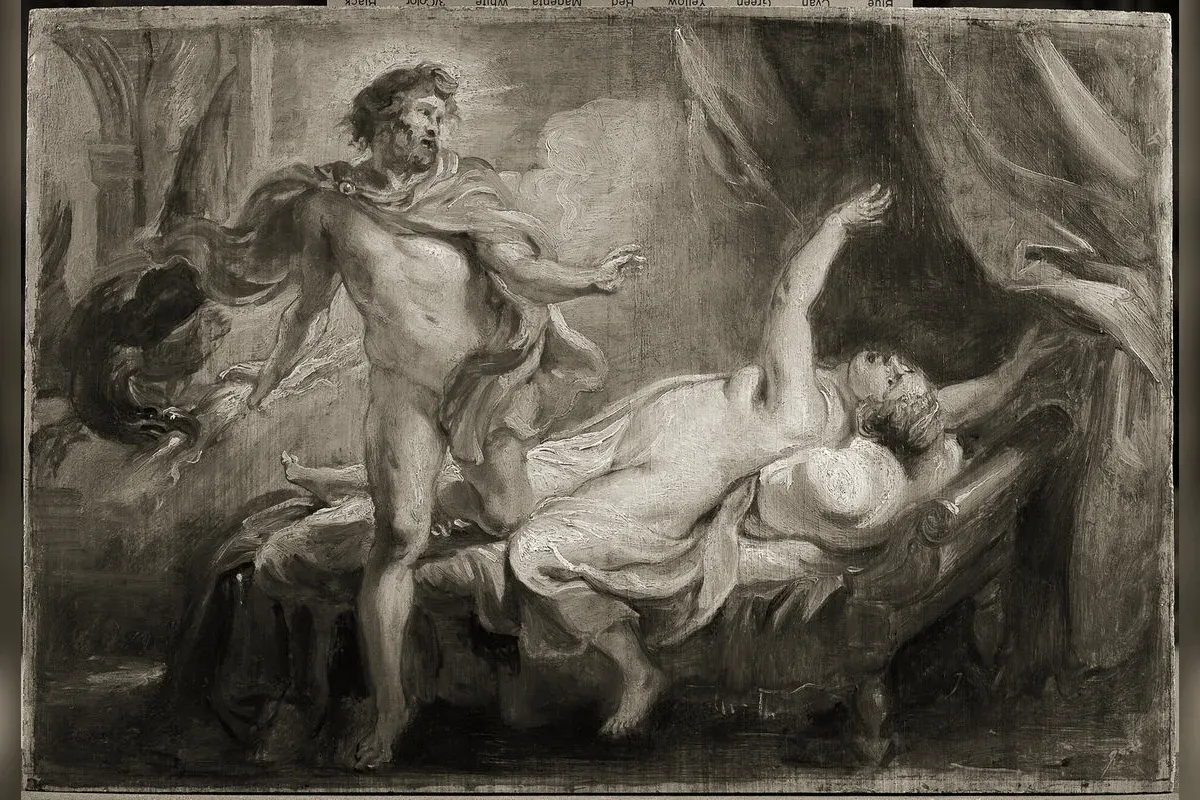
Semele is the Theban princess whose death becomes the second birth of Dionysus. A daughter of Cadmus and Harmonia and lover of Zeus, she is the mortal mother of a major Olympian — and the mother whom that god later retrieves from the underworld.
A promise that cannot be survived
Zeus visits Semele in a form a human body can endure. When Hera discovers the affair, she approaches in disguise, appearing in different accounts as an old woman or Semele’s nurse Beroe. She suggests that the lover may only be claiming to be Zeus and advises Semele to demand proof.
Semele first makes Zeus swear that he will grant an unnamed request. She then asks him to appear as he does before Hera. Bound by his oath, Zeus comes with thunder and lightning; the chamber burns and Semele dies.
The episode is often reduced to fatal curiosity, but its mechanism is more exact. Semele asks for certainty in a relationship built on disguise. The proof is genuine, and that is precisely why it kills her: the difference between divine and mortal cannot be removed without destroying the mortal witness.
Dionysus before Dionysus
Semele is six months pregnant. Zeus rescues the unborn child from the fire and sews him into his thigh until he reaches term. Dionysus is consequently the twice-born god, delivered first from a dying mother and then from his father’s body.
Semele’s sisters reject the divine explanation. They say she became pregnant by an ordinary man, invented Zeus as a cover, and was struck down for the lie. Euripides makes this family slander the starting point of the Bacchae. Dionysus returns to Thebes to establish his worship, vindicate his mother, and punish a royal house that denies who he is.
From Semele to Thyone
Her death is not the endpoint. Once Dionysus has secured his divine standing, he descends to the underworld and brings Semele back. On Olympus she receives immortality and the name Thyone.
No other mortal mother loved by Zeus receives quite this reversal. Dionysus does more than survive Semele: he changes her status from a woman destroyed by divine presence into a goddess able to inhabit it. Thebes nevertheless continued to show a tomb or ruined chamber associated with Semele near the house of Cadmus. The landscape held both versions together — the burned princess below and the immortal mother above.
Ancient sources
- Hesiod, Theogony, 940-942
- Euripides, Bacchae, 1-63, 88-104
- Apollodorus, Library, 3.4.3
- Diodorus Siculus, 4.2, 4.25
- Pausanias, Description of Greece, 2.31.2; 9.12.3
See also
Frequently asked questions
Why is Dionysus called twice-born?
Because he is carried to term twice. When the lightning kills Semele, Zeus takes the unborn child from her body and sews it into his own thigh until the months are complete. Dionysus is therefore gestated first by a mortal woman and then by a god — which is exactly the ambiguity the cult exploits, since he is the Olympian who remains half human and arrives among the gods from outside.
Was Semele originally Greek?
Possibly not. Her name has long been connected with a Phrygian or Thraco-Phrygian earth goddess, which would fit the wider pattern of Dionysus arriving in Greece from the north and east. The connection is a linguistic hypothesis rather than a settled fact, but it aligns with the way the myths themselves insist on his foreignness.