Greek mythology · Heroes & mortals
Phaethon, son of Helios in Greek mythology
Phaethon, son of Helios: a taunt about his paternity, an oath by the Styx his father could not break, and the day the chariot of the Sun burned the earth.
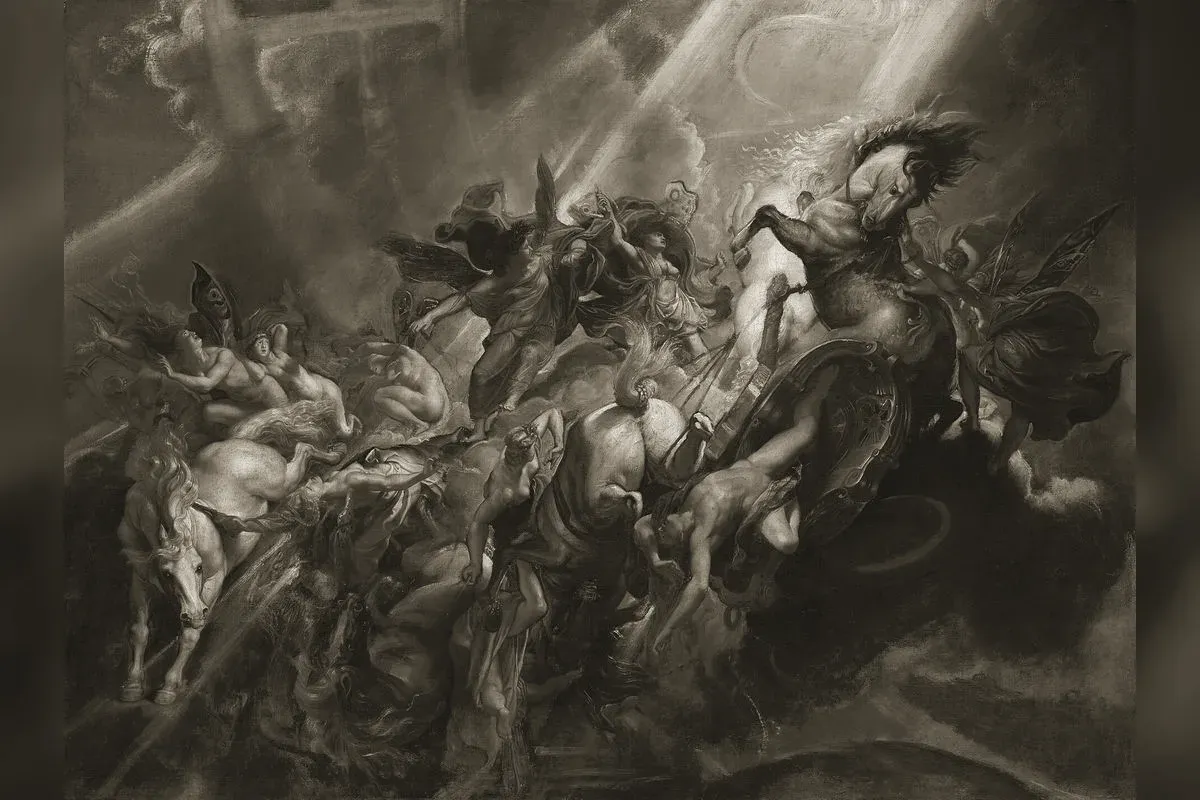
Phaethon is the son of Helios who asks to drive the chariot of the Sun for one day and nearly burns the world. Ovid gives him four hundred lines of Metamorphoses — one of the longest single episodes in the poem — and it is the best surviving Greek account of what happens when a father cannot say no.
A taunt about paternity
The trouble starts with an insult. Epaphus, a son of Zeus, tells Phaethon he is a fool to believe his mother Clymene about who his father is.
Phaethon goes to Clymene, who swears by the Sun itself that he is Helios’ son and tells him to go and ask. So the journey to the palace of the Sun is not a quest for a gift. It is a boy trying to obtain proof of his own legitimacy, and everything that follows is the answer he is given.
Ovid stages the arrival with a long description of the palace: doors of silver worked by Vulcan showing the sea, the land and the sky, the Hours and Seasons standing round the throne, and the god seated in emeralds with a light no one can look at directly. Then Helios recognises him, calls him son, and — to remove any doubt — swears by the Styx to give him whatever he asks.
The unbreakable oath
Phaethon asks for the chariot.
Helios spends the next hundred lines trying to talk him out of it, and the argument is remarkable because it is entirely practical. The horses breathe fire and barely obey him. The first stretch is so steep that he is frightened looking up it; the middle is so high that he does not dare look down; the last drops so sharply that Tethys fears for him every evening. The sky turns underneath, and everything wheels against him while he drives against it. Ask for anything else — ask for something a father should give.
The boy refuses to be dissuaded, and the oath by the Styx binds even a god. Helios anoints his son’s face against the flames, warns him to hold the middle path and to use the reins rather than the whip, and lets him go.
The scorching
The horses feel a lighter load and bolt. The chariot rises until it terrifies the constellations — the Serpent, torpid at the pole, grows hot and vicious; Scorpio sweats venom — and then plunges.
Mountains catch: Ovid lists them by name, Athos, Taurus, Helicon, Parnassus, the Alps. Rivers dry in their beds. Libya becomes desert. Ethiopia’s people are darkened when the blood is drawn to the surface of their skin — an aetiology for human variation that says as much about Roman ethnography as about myth. The sea shrinks, and Poseidon cannot raise his head above it three times without being driven back by the heat.
Earth herself finally speaks — scorched, choking, her hair on fire — and asks Jupiter what she has done to deserve this, and whether chaos is being restored. Jupiter climbs to the height from which he sends rain, finds no cloud left anywhere, and kills the boy with a thunderbolt to save the world.
Amber
Phaethon falls burning into the river Eridanus, and the naiads bury him. His sisters, the Heliades, stand over the grave weeping until their feet root, bark closes over their thighs, and their arms become branches — and their tears, hardening in the sun, drop into the river as amber. His companion Cycnus, mourning, becomes a swan.
The story is doing real work here. Amber was a genuine luxury import reaching the Mediterranean from the north, and the Greeks knew it came down river routes from somewhere beyond their maps. The myth supplies an origin for a valuable substance that arrived from an unknown place, and does it by making it a residue of grief.
Ancient sources
- Ovid, Metamorphoses, 1.750-2.400
- Euripides, Phaethon, fragments
- Apollonius of Rhodes, Argonautica, 4.595-626
- Hyginus, Fabulae, 152A
See also
Related entries
Frequently asked questions
Why can't Helios refuse?
Because he swore by the Styx, an oath that binds even a god. He spends a hundred lines trying to talk his son out of it, and the argument is entirely practical: the horses breathe fire and barely obey him, the first stretch is so steep he is frightened looking up it, the middle so high he dares not look down, and the sky turns underneath while he drives against it. Knowing all of it changes nothing.
What damage does the ride do?
Ovid catalogues it. The chariot climbs until it terrifies the constellations, then plunges. Mountains catch fire — Athos, Taurus, Helicon, Parnassus, the Alps — rivers dry in their beds, Libya becomes desert, and the sea shrinks. Earth herself finally speaks, scorched and choking, to ask Jupiter whether chaos is being restored. He climbs to the height from which he sends rain, finds no cloud anywhere, and kills the boy with a thunderbolt to save the world.